Essay · 6 min read
Why dresses don't have pockets
If you wear dresses much, you know the moment. You're heading out, you reach to stash your phone or your keys, and there is nowhere. The dress has fake pockets, or no pockets, or pockets shaped roughly like a tongue depressor. Cool.
This isn't a fluke. The reason your dress has nowhere to put your stuff goes back about three hundred years, and once you trace it you stop being annoyed at any one designer and start being annoyed at the entire history of European tailoring — which, for what it's worth, is more satisfying.
Pockets used to be fair
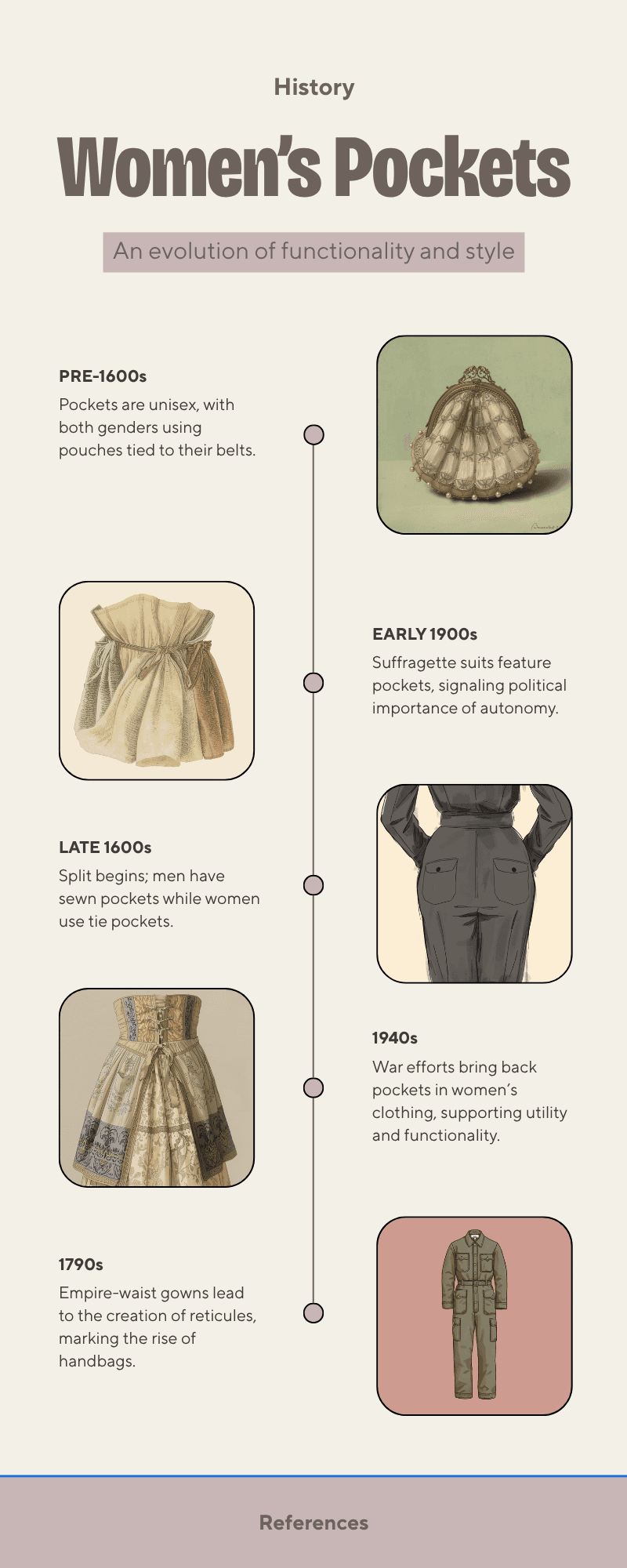
Before the late 1600s, almost nobody had pockets sewn into their clothes. Men, women, everyone — they carried small pouches tied at the waist, on the outside, often beautifully embroidered. What was in the pouch told people who you were. The pouch itself was just a pouch.
Then European tailoring split.
In the late 1600s, English and French tailors started building pockets directly into men's coats, waistcoats, and breeches. The pocket became part of the garment: hidden, internal, permanent. For women, pouches stayed separate. They evolved into "tie pockets" — pairs of cloth pouches, sometimes gorgeously embroidered, worn under the petticoat and reached through slits cut into the skirt.
Worth flagging: women in this period were not actually pocket-poor. Barbara Burman and Ariane Fennetaux's 2019 book The Pocket: A Hidden History of Women's Lives, 1660–1900 is full of inventories of what women actually carried, and it's a lot. Snuffboxes, sewing kits, scissors, pocket watches, food, money, books, letters, small bottles. A pair of 18th-century tie pockets carried more than most modern handbags.
The split — sewn in for men, tied on for women — is the seed of everything that came after.
The 1790s, when fashion ate the pocket
Then came the French Revolution and, in dress, the neoclassical turn. Empire-waist gowns, high under the bust, narrow skirts modeled (loosely) on Greek statuary. The fabric clung. There was simply no room underneath for a pair of bulky tie pockets.
So tie pockets went away. What replaced them was the reticule — a small handheld bag, which contemporaries mocked as a "ridicule" because, well, you used to be able to carry a book and now you couldn't.
This is the part of the story I find a little wild: the modern handbag exists essentially because women's clothes stopped having room. Every It-bag in your feed descends from a logistical workaround.
The suffragettes noticed
By the late 19th century, the missing pocket had become a political complaint. The Rational Dress Society, founded in London in 1881, argued for clothing women could actually move and work in. Charlotte Perkins Gilman returned to pockets repeatedly in The Forerunner in 1915 — what does it mean, she asked, to walk out the door with what you need on you, rather than having to ask someone else to hold it.
Suffragette tailored suits in the early 1900s often featured large, prominent pockets. The point was simple. A woman could carry her own keys, her own money, her own pamphlets, and it was no one else's business.
Wartime brought them back. 1947 took them away again.
During both world wars, as women moved into factories, military auxiliaries, and every kind of public-facing job, utility clothing came back. Boilersuits, uniforms, workwear, all of it pocketed, because work requires pockets. For about a decade the gap almost closed.
Then Christian Dior happened. His 1947 "New Look" collection — nipped waist, padded hips, full calf-length skirt — was a deliberate rejection of wartime austerity, and it was almost entirely pocket-free. The silhouette became the postwar template for women's "elegant" dressing, and the pattern has held since. Utility clothing has pockets. "Elegant" clothing mostly doesn't.
Why this is still happening in 2026
A few reasons, none of them especially flattering. Cost is the most boring one: a real working pocket is a few cents of fabric and a few seconds of stitching, and at fast-fashion margins those cents matter, so skipping them ships the dress cheaper. Aesthetics is the next — pattern-makers are still trained to treat a smooth, uninterrupted line as the default for women's eveningwear and a lot of casualwear, with pockets as a feature you justify rather than one you assume. Then there's the handbag industry, which is enormous, global, and is doing nothing to encourage the option of putting your phone in your dress. And finally inertia. New patterns are adapted from old patterns. Pocketless in, pocketless out.
What has actually shifted
The last few years did something. Pocket-checking videos went viral on TikTok. Searches for "dresses with pockets" have climbed year over year on Pinterest, Google, and Etsy. Reviews on retailer sites now treat "has pockets!" as a headline feature rather than a footnote.
Indie brands and made-to-order sellers led most of this, and bigger retailers are catching up unevenly. A few flag pockets in product copy. Almost none let you filter by them. Which is the gap ThePocketDress was built to close — every dress is rated on a four-tier scale from Pocket Mentioned to Phone-Fit Verified, so you search once instead of opening forty tabs.
The history of pockets isn't a conspiracy. It's just the slow accumulation of decisions made by tailors in 1690 and a designer in 1947 and a pattern-maker last spring, almost none of them thinking specifically about you. The result is a world where reaching for your phone in a dress is, more often than not, a small humiliation.
The fix is also small. A seam, a stitch, a filter. We're not asking for the moon, just a place to put it.
Further reading
- Barbara Burman & Ariane Fennetaux, The Pocket: A Hidden History of Women's Lives, 1660–1900 (Yale University Press, 2019)
- Hannah Carlson, Pockets: An Intimate History of How We Keep Things Close (Algonquin, 2023)
- Charlotte Perkins Gilman, The Dress of Women (serialized in The Forerunner, 1915)